The Box Instinct: AI Is Not One Thing
Imagine the paper that reaches the executive committee of Nordvik Region, a fictional regional public authority, in January 2027. The scene is illustrative. The paper is four pages long and headed "The AI system: status, costs and risks". Page one has a diagram: a rectangle labelled "AI system" in the middle, arrows to a rectangle labelled "case management" and another labelled "residents", and a cloud shape above them all. Page two has a budget line and page three a risk line with a single rating. Page four asks the committee to decide whether the system should continue, be paused or be expanded.
The question is a fair one, and it cannot be answered as put, because the thing in the rectangle is not one thing. The Region's AI register, which the committee has not been shown, lists thirteen entries. One ranks applications for financial assistance by urgency and is a high-risk AI system under the AI Act, Regulation (EU) 2024/1689 as amended by Regulation (EU) 2026/1744 (39, European Union, 2024) (40, European Union, 2026). One answers residents' questions from published information without a person approving each answer. One is a set of features that software vendors switched on inside products the Region licenses, which nobody in the Region chose. Two are not yet running and one is paused. Pausing "the AI system" would pause some of these, could not pause others, and would make no difference to the features the vendors run.
The paper's author cannot be blamed: a board paper has to fit on four pages, and a rectangle is the usual way to show a committee a system. This chapter is about what the rectangle hides: three test questions, the European statistics on how many technologies, purposes and cloud services sit behind "AI" and "the cloud", and Nordvik Region's thirteen entries drawn in the notation of Chapter 4.
The questions
Three questions of the test belong to this chapter. No published survey asked a comparable population, so all three are self-test questions: the only perception data are your own answers.
Question 4 asked: Of the EU enterprises that used AI in 2025, what share used three or more different AI technologies? The options were: About one in ten; About four in ten; About eight in ten. Eurostat publishes how many enterprises with ten or more persons employed use at least one, at least two and at least three of a list of AI technologies, as shares of all enterprises; in 2025, 19.95 per cent used at least one and 8.28 per cent at least three (9, Eurostat, 2026). Dividing the second share by the first gives about 41.5 per cent of the AI-using enterprises. That is my estimate, because Eurostat publishes both as shares of all enterprises and I have divided one by the other. The answer is about four in ten.
Question 5 asked: In 2025, what share of EU enterprises bought at least one paid cloud computing service? The options were: About 25 per cent; About 50 per cent; About 80 per cent. Eurostat's cloud module gives 52.74 per cent of enterprises with ten or more persons employed in 2025, and 84.67 per cent of large enterprises with 250 or more (10, Eurostat, 2026). The answer is about 50 per cent; the third option is close to the figure for large enterprises, not the average one.
Question 10 asked: What was the most common purpose for which EU enterprises used AI in 2025? The options were: ICT security; Production processes; Marketing or sales. Eurostat asks the AI-using enterprises what they use the technologies for. In 2025, 19.77 per cent of them used AI for ICT security, 20.76 per cent for production processes and 34.7 per cent for marketing or sales (9, Eurostat, 2026). The answer is marketing or sales. As a share of all enterprises, not only of the users, the lead is narrower: 6.92 per cent for marketing or sales and 6.19 per cent for business administration or management (9, Eurostat, 2026). Among large enterprises the order is different, and that is itself a lesson about the box.
The tempting options share one picture: a single AI technology per enterprise, a single cloud that an organisation is in or out of, a single kind of use.
The instinct
I call it the box instinct: the habit of drawing AI as one box, and "the cloud" as one cloud, when the measured landscape is many uses of many kinds at many levels. The other eight instincts of this book stand on it: you cannot see that uses differ in autonomy, reversibility or who decides about them until you have stopped seeing them as one.
The instinct is useful almost everywhere else. A budget needs a line, a system needs an owner, and a committee with an hour for twelve items needs each item to be one thing it can approve, pause or reject. Hans Rosling found that people carried a two-box picture of the world, developed and developing, long after the data had placed most of humanity between the boxes, and he replaced them with four income levels drawn the same way every time (8, Rosling et al., 2018). The AI box is a convenient picture, not a good one.
It misleads here because the things inside the box differ in exactly the properties that decide what they can do to an organisation and the people it serves. The first of those properties is the usage mode, the way an organisation came to use a model. AI Governance concluded that using a large language model is not one activity but at least six, and gave the six modes this book adopts, from Mode 0 Ambient AI, features a supplier switches on inside software the organisation already licenses, to Mode 5 Autonomous production agents, which act on business systems with an identity of their own (2, Nordqvist, 2026). One risk rating, one owner and one decision applied to six kinds of thing will be right for some and meaningless for the rest.
The box also hides what nobody chose. AI Red Team found that Mode 0 is the blind spot: vendor AI in security products and managed services may already act at a level of autonomy nobody in the organisation decided (4, Nordqvist, 2026). A box labelled "AI system" cannot contain a feature the organisation did not buy as AI. This is why the notation draws a unit, one way of putting a model to work, and not a system, a vendor or a product: the same model used in two ways is two units. This chapter's job is to get the count right.
Author's note needed: A short passage, one or two paragraphs, from the author's own practice would fit here: a meeting in which a board or an executive team was shown one box labelled "AI" and asked to decide about it, what the author asked, and how many things turned out to be in the box. It should show the instinct at work in a real room without naming the organisation.
The same instinct draws "the cloud". An executive asks whether the organisation is "in the cloud"; a journalist asks whether an authority's data are "in the American cloud". Each treats as one thing what the data describe as a stack of services, bought one at a time over more than a decade. The questions cannot be answered until they are made plural.
The evidence
Three Eurostat datasets, described in Appendix C, let us count instead of guess. Each is counted by a statistical office and published with its method.
Several technologies per enterprise
Since 2021 Eurostat has asked enterprises, technology by technology, whether they use it: text mining, speech recognition, generating language or code, image recognition, machine learning, process automation, autonomous machines and, from 2025, generating pictures, video or sound. "Uses at least one AI technology" is an aggregate derived from those answers, not a question anyone was asked. The survey was not run in 2022, and the 2025 aggregate rests on eight technologies where the earlier years had seven, so part of the rise between 2024 and 2025 may be the longer list rather than wider use (9, Eurostat, 2026).
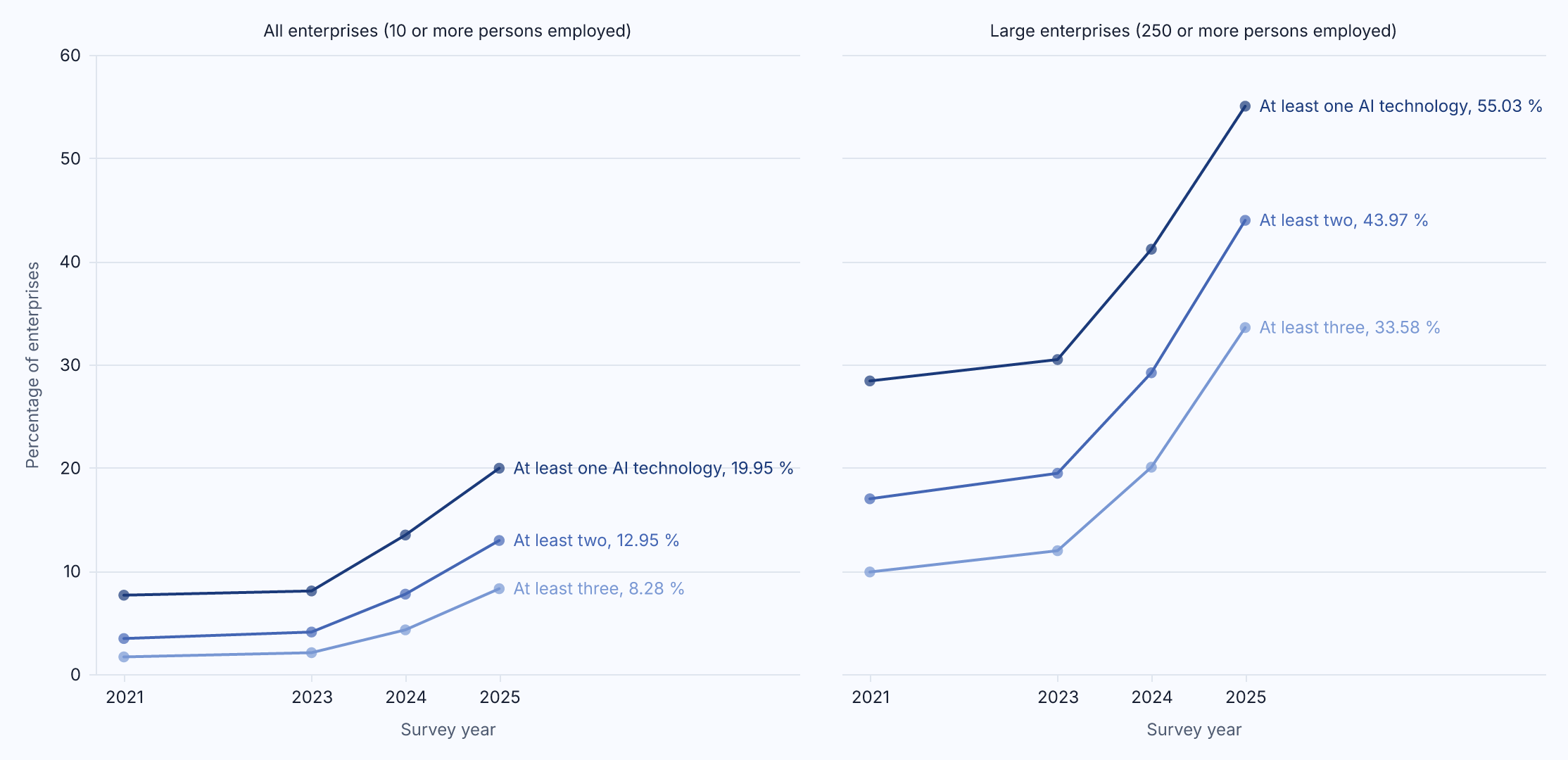
Figure 5.1: Enterprises using at least one, at least two and at least three of the listed AI technologies, EU, 2021 to 2025, as a share of all enterprises with ten or more persons employed (left) and of large enterprises with 250 or more (right); the AI module was not run in 2022 and the 2025 list is one technology longer. Source: Eurostat, Artificial intelligence by size class of enterprise, isoc_eb_ai (retrieved 2026).
In the left panel, the average enterprise, the share using at least one technology rose from 7.65 per cent in 2021 to 8.06 per cent in 2023, 13.48 per cent in 2024 and 19.95 per cent in 2025; the share using at least two rose from 3.45 to 12.95 per cent over the same years, and the share using at least three from 1.67 to 8.28 per cent (9, Eurostat, 2026). Dividing as I did for Question 4 gives about 65 per cent of the AI users with at least two technologies and about 41.5 per cent with at least three, both my estimates. The single-technology enterprise that the box pictures is a minority of the users.
In the right panel, among large enterprises, 55.03 per cent used at least one technology in 2025, 43.97 per cent at least two and 33.58 per cent at least three (9, Eurostat, 2026). By the same division, about 80 per cent of the large AI users used two or more technologies and about 61 per cent three or more, so in a large organisation "we use AI" means "we use several kinds of AI". At the top of the list are text mining, at 11.75 per cent of all enterprises in 2025, and generating pictures, video or sound, at 9.55 per cent; autonomous machines come last at 1.39 per cent (9, Eurostat, 2026). The commonest kinds are text, pictures and sound, not machinery.
Several purposes
The second dataset asks the AI-using enterprises what they use AI for, with seven purposes on the list since 2023, and publishes the answers as shares of the AI users, a base of about a fifth of all enterprises (9, Eurostat, 2026).
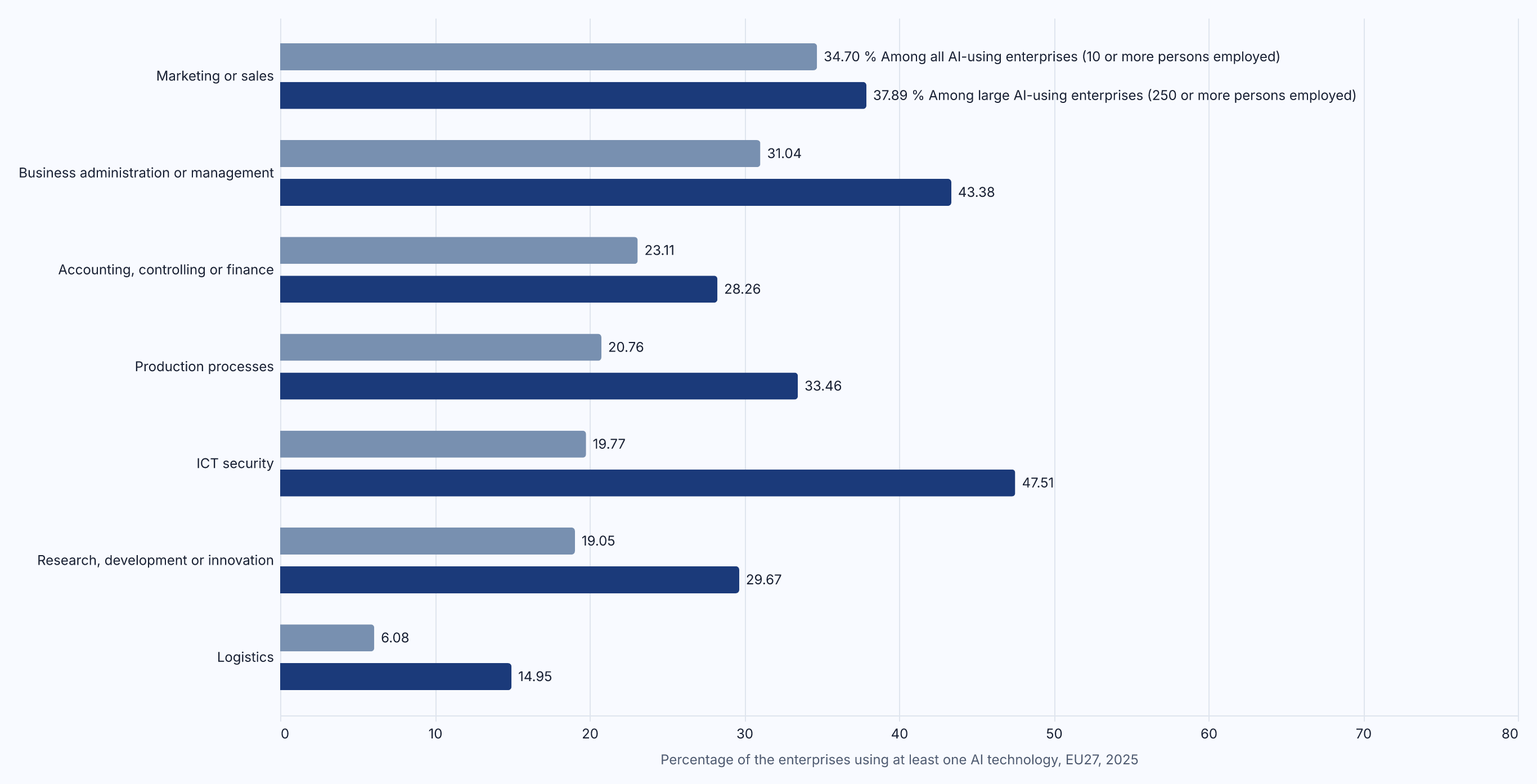
Figure 5.2: The seven purposes for which enterprises use AI, EU, 2025, as a share of the enterprises using at least one AI technology, among all enterprises with ten or more persons employed and among large enterprises with 250 or more, sorted by the all-enterprises share. Source: Eurostat, Artificial intelligence by size class of enterprise, purpose-of-use indicators, isoc_eb_ai (retrieved 2026).
Among all AI-using enterprises in 2025, 34.7 per cent used AI for marketing or sales, 31.04 per cent for business administration or management and 23.11 per cent for accounting, controlling or finance, with production processes, ICT security and research between 20.76 and 19.05 per cent and logistics last at 6.08 per cent (9, Eurostat, 2026). The most common AI use in the average European enterprise is the office, not the factory floor or the server room. And the purposes overlap: of the AI users, 73.39 per cent named at least one of the seven purposes, 39.78 per cent at least two and 21.18 per cent at least three (9, Eurostat, 2026). The remaining quarter named none of the seven, because every list has edges.
The large enterprises reorder the list. Among large AI-using enterprises, 47.51 per cent used AI for ICT security, 43.38 per cent for business administration or management and 37.89 per cent for marketing or sales, and 39.27 per cent named at least three purposes (9, Eurostat, 2026). ICT security is the right answer for large enterprises and the wrong one for the EU average. The box instinct is not only the habit of seeing one thing where there are several; it is also the habit of taking the one you know for the whole.
The cloud is a stack
The Eurostat series used here starts in 2014: enterprises are asked whether they buy paid cloud computing services over the internet, and which ones. The headline share rose from 17.82 per cent in 2014 to 36.1 per cent in 2020 and 52.74 per cent in 2025, and among large enterprises from 31.56 to 84.67 per cent (10, Eurostat, 2026). It is the number behind Question 5, and the number the box instinct stops at.
Underneath it the services were bought at different rates. In 2014, 12.18 per cent of enterprises bought e-mail as a cloud service and 2.93 per cent bought computing power to run their own software; in 2025 the two stood at 44.91 and 14.86 per cent (10, Eurostat, 2026). E-mail has been the most bought service in every survey year; computing power, the service the word "cloud" brings to an engineer's mind, is among the least.
Eurostat groups the ten services it asks about into basic (e-mail, office software, file storage, computing power), intermediate (finance, customer-relationship and enterprise resource planning software) and sophisticated (security software, database hosting, development platforms). It redefined the grouping in 2021, so Figure 5.3 draws only years that share one definition (10, Eurostat, 2026).
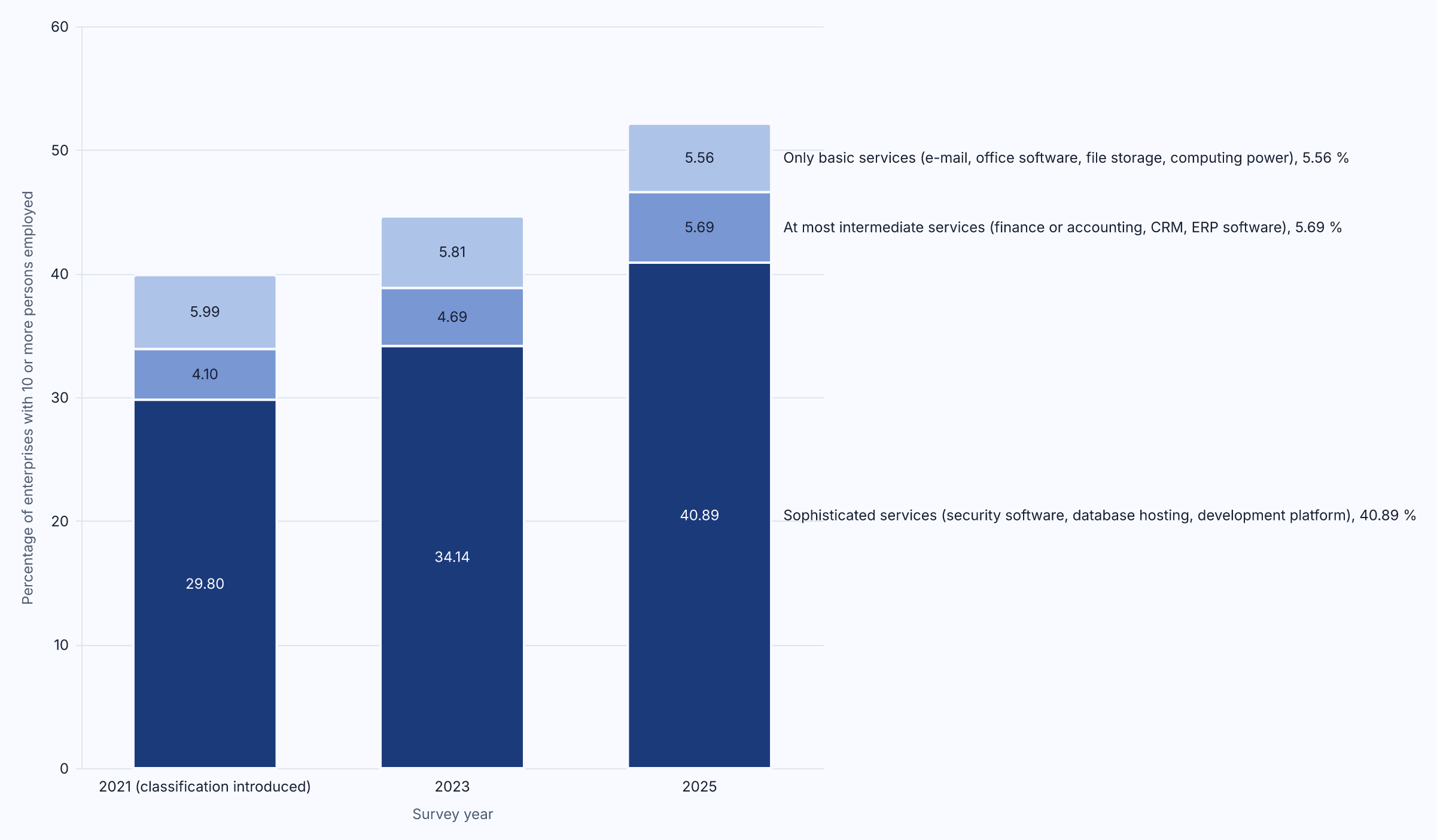
Figure 5.3: Enterprises buying paid cloud computing services, EU, 2021, 2023 and 2025, as a share of enterprises with ten or more persons employed, stacked by the most sophisticated kind of service bought: only basic, at most intermediate, or sophisticated; the classification was introduced in 2021 and earlier years are not comparable. Source: Eurostat, Cloud computing services by size class of enterprise, isoc_cicce_use (retrieved 2026).
In 2025, 5.56 per cent of enterprises bought only basic services, 5.69 per cent at most intermediate ones and 40.89 per cent at least one sophisticated service; in 2021 the three stood at 5.99, 4.1 and 29.8 per cent (10, Eurostat, 2026). The three layers add to 52.14 per cent in 2025, by my sum, 0.6 points below the 52.74 headline; Eurostat publishes both and I have not found the reason. The growth since 2021 is almost entirely in the top layer. The number also depends on which layers you count. The Digital Decade, the Commission's programme of digital targets for 2030, measures cloud by counting the sophisticated and intermediate layers together, which gave 46.69 per cent in 2025 rather than the 52.74 per cent headline (10, Eurostat, 2026) (15, European Commission, 2026). Two honest figures, six points apart, because "the cloud" is not one thing.
What the datasets cannot show matters too. They count enterprises, not public authorities, and they do not ask who hosts a service, under which jurisdiction, with what identity a model acts, in which usage mode or at which autonomy level. That is the gap the notation fills.
The picture corrected
Figure 5.4 is Nordvik Region's landscape on 1 January 2027 in the first standard view, V1, the one-page landscape. It is illustrative: the picture is rendered from the fictional authority's landscape model, and nothing in it is data.
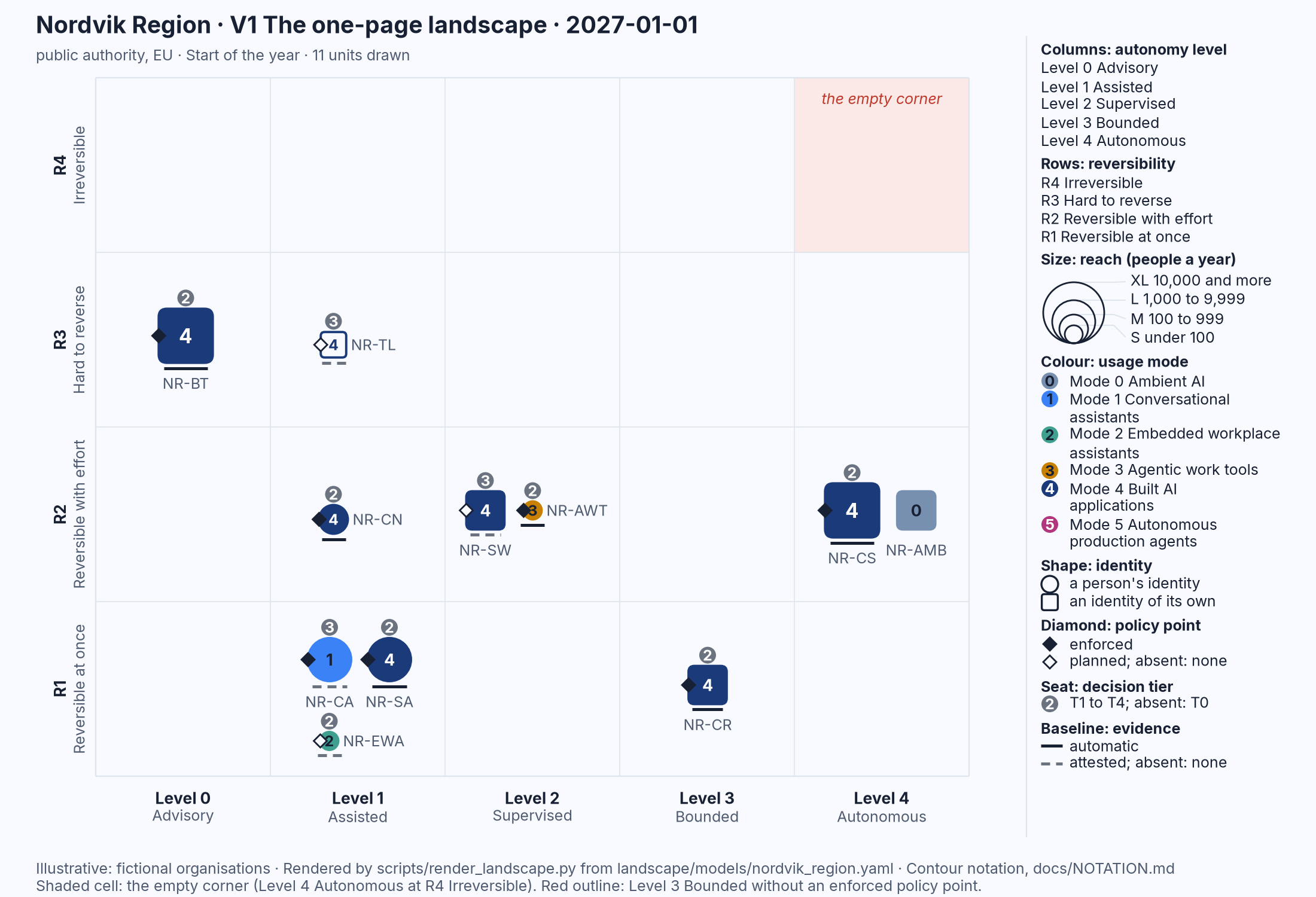
Figure 5.4: Nordvik Region's landscape at the start of 2027, V1 the one-page landscape: eleven units drawn, in five usage modes. Illustrative: rendered from landscape/models/nordvik_region.yaml.
The columns are the five autonomy levels, what the AI may do without a person approving each action, that AI Red Team defines: Level 0 Advisory, where the AI suggests and a person decides and acts, to Level 4 Autonomous, where it selects and executes actions within bounds set in advance (4, Nordqvist, 2026). The rows are the four reversibility tiers, R1 Reversible at once at the bottom to R4 Irreversible at the top. Eleven units are drawn; the model holds thirteen, two of them planned for later in the year. The empty corner at the top right, Level 4 Autonomous at R4 Irreversible, is empty.
Now count the colours. Seven of the eleven marks are the dark blue of Mode 4 Built AI applications, and the two planned units will make nine. Among them are the benefits-triage system, NR-BT, at Level 0 Advisory and R3 Hard to reverse, and the citizen-service assistant, NR-CS, at Level 4 Autonomous and R2 Reversible with effort. Both are XL, the largest of the four reach classes, meaning a unit touches 10,000 or more people a year, and both are squares, units acting with an identity of their own. One mark is the bright blue of Mode 1 Conversational assistants, NR-CA; one the green of Mode 2 Embedded workplace assistants, NR-EWA, a small circle in pilot, acting with a person's identity; one the amber of Mode 3 Agentic work tools, NR-AWT. And one is the grey of Mode 0 Ambient AI, NR-AMB, a square at Level 4 Autonomous and R2 with no diamond, no seat and no baseline. The diamond is the policy point, the control outside the model that checks what a unit may do; the seat is the grey tag naming the tier of the person who holds the decision about the unit; the baseline is the line showing where proof that the controls hold comes from. NR-AMB is the features the vendors switched on, acting at a level nobody set, with nobody named to decide and no evidence of any constraint. Five modes, eleven marks, and the one that would worry me most as a committee member is the one the paper could not have contained.
Count the shapes next: six squares and five circles. Ten marks carry a seat, seven at T2, the system owner, and three at T3, an executive; NR-AMB carries none.
The second view answers the question about "the cloud". Figure 5.5 is V3, the supply and sovereignty view: the same eleven marks, placed in containers by who operates them and where.
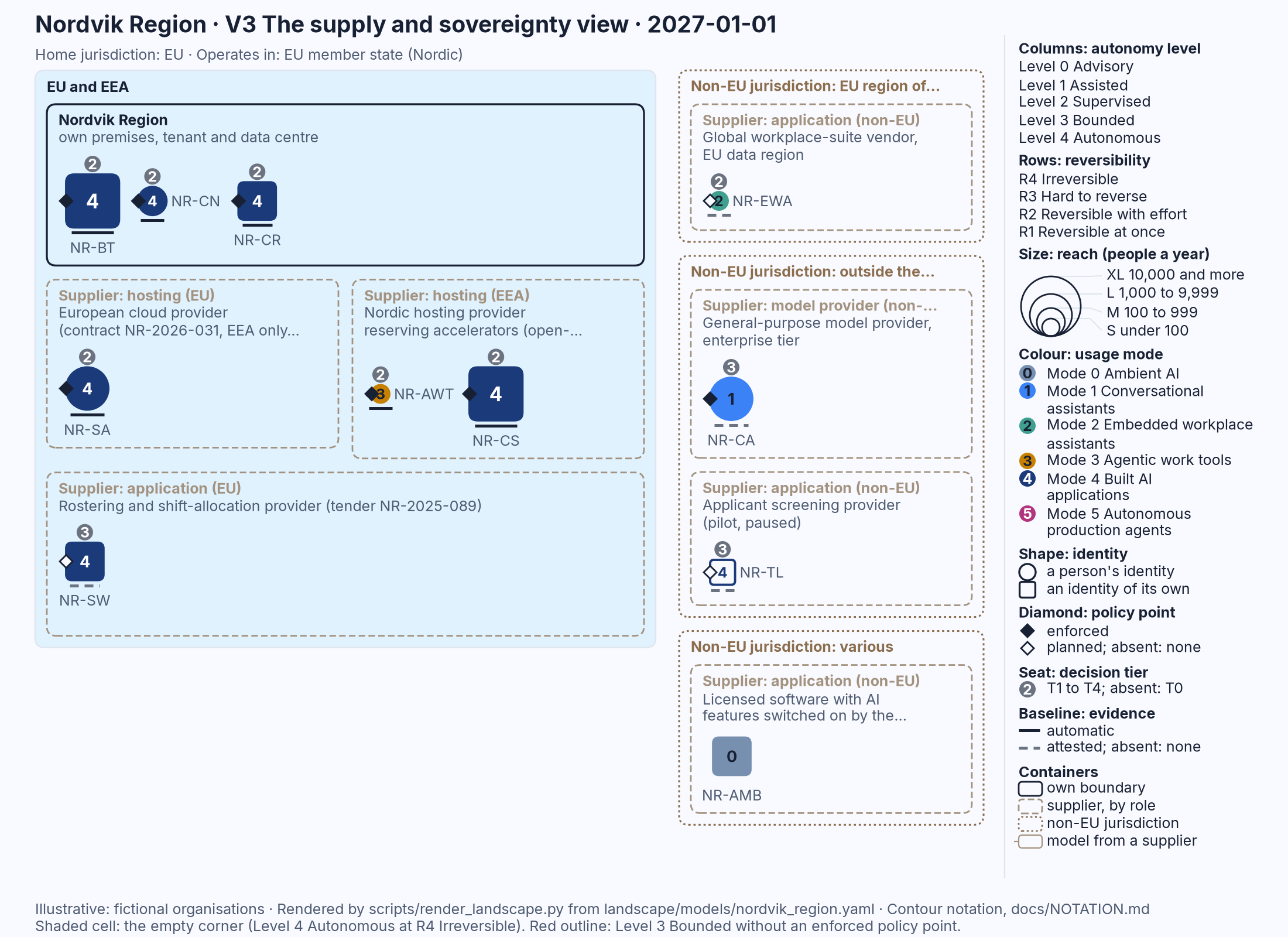
Figure 5.5: Nordvik Region's landscape at the start of 2027, V3 the supply and sovereignty view: the same units placed in boundary containers by supplier role and jurisdiction. Illustrative: rendered from landscape/models/nordvik_region.yaml.
The large pale area on the left is the European Union and the European Economic Area. Inside it, the solid-bordered container is the Region's own boundary, holding the benefits-triage system, the case-note summariser and the correspondence classifier. Three dashed containers are suppliers, labelled by role and never by brand: a hosting supplier in the EU, where the staff assistant runs; a hosting supplier in the EEA, where the citizen-service assistant and the agentic tools run; and an application supplier in the EU, the rostering provider. On the right, three dotted containers hold suppliers under a jurisdiction outside the EU: a global workplace-suite vendor, whose embedded-assistant pilot runs in an EU data region under a non-EU supplier; the conversational assistant's model provider, together with the paused applicant-screening provider; and "various", the licensed software whose vendors switched the features on, holding the Mode 0 mark.
"Is Nordvik Region in the cloud?" has no answer. The view answers the plural questions: three units on premises, three with European hosting suppliers, one with a European application supplier, and four operated from outside the EU, one of them the features nobody chose. AI Platform and Security concluded that digital sovereignty is a set of verifiable properties, knowing where a workload runs and which law governs it, being able to move it and being able to continue if a provider fails, rather than a location (3, Nordqvist, 2026). The supply view is that conclusion drawn: a container per role, a border per jurisdiction, and the Mode 0 features placed where they are. Chapter 16 teaches the view in full.
The rule of thumb
Rule of thumb: When someone says "the AI" or "the cloud", ask which ones, and count them before you judge them.
The rule has two halves, and the order matters. "Which ones" turns a box into a list: it makes the speaker name the units, and a committee that can see thirteen things will not try to pause them with one vote. "Count them before you judge them" is the harder discipline, because the judgement is usually formed already and the count feels like a delay. A count of thirteen units in five modes tells you where to look first: at the one with no seat, at the two that are XL, at the one in the rightmost column.
The rule stops applying when the units are known; the other instincts then take over, beginning with the binary instinct of Chapter 6. Nor is aggregation wrong: the Eurostat headline, 19.95 per cent of enterprises using at least one AI technology, is a useful number (9, Eurostat, 2026). The rule asks only that you know you are looking at an aggregate, and that you can open it when you need to.
What to do
For an executive
Refuse the box without refusing the paper. When a paper reaches you with "the AI system" or "the cloud" in its heading, ask for one line per unit before the meeting: what it does, in which usage mode, with whose identity, how many people it touches in a year and who holds the decision about it. Do not assume the list exists: AI Governance reports that the most common finding in AI governance assessments is that the organisation does not know how many AI systems it operates, and concludes that you cannot govern what you cannot enumerate (2, Nordqvist, 2026). Then ask for the units drawn rather than the box, and ask three questions: which mark has no seat, which marks are XL, and which marks sit in the rightmost column. A single risk rating for a landscape belongs to no unit; ask which one it means.
For an architect
Turn "we use AI" into a count, and make the count the first draft of a landscape model. The usage-mode register that AI Governance, Chapter 2, describes, which its Chapter 9 turns into the AI inventory, already has the columns the first draft needs: an identifier, a name and the usage mode (2, Nordqvist, 2026). The fragment below is condensed from Nordvik Region's model, with the unit names shortened: thirteen units and their modes on 1 January 2027. It is illustrative and deliberately incomplete; the model asks for the other six dimensions before a view can be drawn, and Appendix A lists them.
# The count: the thirteen units of Nordvik Region and their usage modes,
# 1 January 2027. Condensed from landscape/models/nordvik_region.yaml
# (illustrative; unit names shortened). The remaining dimensions of each
# unit follow in the model.
organisation: {id: nordvik, name: Nordvik Region, kind: public-authority}
units:
  - {id: NR-BT,  name: Benefits-triage system,               mode: 4}
  - {id: NR-SA,  name: Internal staff assistant,             mode: 4}
  - {id: NR-CS,  name: Citizen-service assistant,            mode: 4}
  - {id: NR-CR,  name: Correspondence classifier,            mode: 4}
  - {id: NR-CN,  name: Case-note summariser,                 mode: 4}
  - {id: NR-SW,  name: Rostering and shift allocation,       mode: 4, status: pilot}
  - {id: NR-TL,  name: Recruitment screening pilot,          mode: 4, status: paused}
  - {id: NR-AMB, name: Ambient AI in licensed software,      mode: 0}
  - {id: NR-EWA, name: Embedded workplace assistant (pilot), mode: 2, status: pilot}
  - {id: NR-CA,  name: Conversational assistants,            mode: 1}
  - {id: NR-AWT, name: Agentic work tools (platform team),   mode: 3}
  - {id: NR-SOC, name: SOC triage assistant,                 mode: 4, status: planned}
  - {id: NR-EXP, name: Exposure prioritisation,              mode: 4, status: planned}
Two habits make the count honest. A unit is a use, not a system: when one product drafts for a person and also acts on its own, write two lines. And write the Mode 0 line even though nobody procured it, because a landscape without it shows what was decided rather than what runs.
For a public official
Make the question plural before you ask it. A parliamentary or council question that asks whether an authority "uses AI" or whether its data are "in the cloud" will receive a true answer that tells you nothing. Ask instead for the list: how many AI uses the authority runs, in which usage modes, how many people each touches, which are high-risk AI systems under the AI Act (those in Annex III, the Act's list of high-risk uses), and where each is hosted and under which jurisdiction. The EU database of high-risk AI systems is expected to hold part of that list, because Article 49(3) of the AI Act requires public authorities that deploy a high-risk AI system listed in Annex III, other than those in point 2, to register themselves and their use of it before putting it into service or using it (39, European Union, 2024) (40, European Union, 2026). AI Governance concluded that a public algorithm register should be generated from the internal inventory so that the two cannot diverge (2, Nordqvist, 2026). A question that asks unit by unit gets a better answer than a question about the box. When the answer comes, draw it; a V1 view fits on one page of a committee paper.
Nordvik Region and Hansa Mutual
Both organisations are illustrative, and the box instinct shows up differently at each. At Nordvik Region it is the committee paper this chapter opened with, and the one-page landscape answers it with thirteen units in five modes and three facts the paper could not carry: one of the two units touching the most residents sits at Level 0 Advisory with a filled diamond and a seat, the unit nobody chose sits at Level 4 Autonomous with neither, and the Region has no Mode 5 Autonomous production agents at all, by choice.
Hansa Mutual's board paper counts seventeen. The group runs units in all six modes, including six Mode 5 agents that act with identities of their own. Its box instinct takes a different form: not one rectangle but one word, "agents", used for six units that differ in reversibility from R1 to R3 and in reach from S to XL. The count also changes with time: in the scenario of Chapter 18, Nordvik Region adds two units during 2027 and retires one, and Hansa Mutual adds none.
Summary
The box instinct draws AI as one box and the cloud as one cloud. It is a useful habit almost everywhere, and it misleads in this landscape because the things in the box differ in exactly the properties that decide what they can do: the usage mode, the identity with which a unit acts, its autonomy, its reversibility, and whether anyone is named to decide about it. One rating, one owner and one decision applied to a box are right for some of its contents and meaningless for the rest, and the box cannot hold the features nobody chose.
The evidence is Eurostat's. In 2025, 19.95 per cent of EU enterprises used at least one AI technology and 8.28 per cent at least three, about four in ten of the users by my division; the most common purpose among all AI users was marketing or sales at 34.7 per cent, and among large users ICT security at 47.51 per cent (9, Eurostat, 2026). The cloud headline, 52.74 per cent of enterprises, sits on a stack of ten services bought at different rates, with almost all the growth since 2021 in the sophisticated layer (10, Eurostat, 2026).
The picture corrected is the one-page landscape, where Nordvik Region's thirteen units in five modes replace the rectangle and the grey mark with no seat, no diamond and no baseline is the one a committee most needs to see, and the supply view, where containers by role and jurisdiction replace the cloud shape. Both are illustrative.
The rule of thumb is: when someone says "the AI" or "the cloud", ask which ones, and count them before you judge them. The next question is whether each unit is automated or not; Chapter 6 shows that the answer is one of five levels, with the line that matters between the second and the third.
Sources
- Nordqvist, G. (2026). AI Governance: Governing Artificial Intelligence in European Enterprises and Public Authorities. aig.geon.se. (2, Nordqvist, 2026)
- Nordqvist, G. (2026). AI Platform and Security: Building and Securing AI Platforms in European Enterprises and Public Authorities. aips.geon.se. (3, Nordqvist, 2026)
- Nordqvist, G. (2026). AI Red Team: AI as an Active Part of Cyber Defence in European Enterprises and Public Authorities. aired.geon.se. (4, Nordqvist, 2026)
- Rosling, H., Rosling, O. and Rosling Rönnlund, A. (2018). Factfulness: Ten Reasons We're Wrong About the World – and Why Things Are Better Than You Think. London: Sceptre. (8, Rosling et al., 2018)
- Eurostat (2026). Artificial intelligence by size class of enterprise. Online data code isoc_eb_ai. (9, Eurostat, 2026)
- Eurostat (2026). Cloud computing services by size class of enterprise. Online data code isoc_cicce_use. (10, Eurostat, 2026)
- European Commission, Directorate-General for Communications Networks, Content and Technology (2026). Digital Decade DESI dashboard: Digital Decade EU-level trajectories and Digital Economy and Society Indicators. (15, European Commission, 2026)
- European Parliament and Council of the European Union (2024). Regulation (EU) 2024/1689 (Artificial Intelligence Act). Official Journal of the European Union, L series, 2024/1689. (39, European Union, 2024)
- European Parliament and Council of the European Union (2026). Regulation (EU) 2026/1744 (Digital Omnibus on AI). Official Journal of the European Union, L series, 2026/1744. (40, European Union, 2026)