The Binary Instinct: Neither Automated Nor Manual
Picture the evaluation meeting for a rostering system at Nordvik Region, the fictional regional public authority that runs through this book as an illustration. The tender is for software that will draft four-week rosters for hospital wards and visit routes for home care, and the questionnaire sent to bidders contains a line that many procurements contain: "Is the system automated?" The bidder has ticked yes. The union representative at the table reads the tick and hears that a machine will decide who works when. The head of home care hears that unit managers will be spared a weekend of spreadsheets. The data protection officer reaches for Article 22 of the GDPR, which concerns decisions based solely on automated processing (41, European Union, 2016).
All three readings are reasonable, and all three miss, because the question cannot be answered with a tick. The system that was procured, drawn in this book as the unit NR-SW, drafts a roster that a unit manager must approve before anyone sees it. It flags a breach of the rest rules and leaves the manager to resolve it. And it can offer an open shift to staff who have opted in; whether it may do so without asking anyone first is what the Region and the unions have to settle in writing. Three actions, three different answers to what the machine does on its own.
"Is it automated?" is the most natural question in the world, and the landscape does not divide that way. In my reading, and the chapter says below how far the data go, much AI at work drafts something for a person who then decides; some acts inside written limits; a little acts without anyone approving each step; and one system can do all three on the same afternoon. This chapter is about the instinct that hides this, the evidence, and the two views of the notation that make it visible.
The questions
Three questions in the test belong to this chapter.
Question 6 asked: "In 2025, what share of people aged 16 to 74 in the EU had used a generative AI tool for work in the previous three months?" The options were: About 15 per cent; About 35 per cent; About 60 per cent. Eurostat's 2025 survey of ICT use in households, the first to ask about generative AI, measured 15.36 per cent of individuals aged 16 to 74 in the EU who had used a generative AI tool for professional purposes in the previous three months (14, Eurostat, 2026). The right answer is about 15 per cent. The same table puts use for any purpose at 32.66 per cent (14, Eurostat, 2026). The denominator is every person aged 16 to 74, workers or not. Two surveys asked neighbouring questions. The Joint Research Centre's AIM-WORK survey of 70,316 people aged 16 to 65 across the 27 member states asked "In the last 12 months, did you use an AI-powered tool when performing your main paid job?"; 29.9 per cent of workers answered yes and 20 per cent used one at least weekly (51, Gonzalez Vazquez et al., 2025), a wider question over a longer period that lands at about twice the Eurostat share. The Ipsos AI Monitor 2025, a vendor survey of 23,216 online adults in 30 countries, asked how likely it was that AI would change how they do their current job in the next five years; on its 30-country average respondents answered very likely in 22 per cent of cases and somewhat likely in 37 per cent, together 59 per cent by my addition (31, Ipsos, 2025). The questions differ in population, period and wording, so the figures are not a rate of change, but the distance between past use and expected change is wide.
Question 13 asked: "Among developers who answered the Stack Overflow survey in 2025, what share said they highly trust the accuracy of AI tools' output?" The options were: Under 5 per cent; About 30 per cent; About 60 per cent. The 2025 Stack Overflow Developer Survey, a self-selected online survey with more than 49,000 responses, asked "How much do you trust the accuracy of the output from AI tools as part of your development workflow?" Of the 33,297 respondents who answered, 3.15 per cent chose highly trust, 29.64 per cent somewhat trust, 21.51 per cent neither, 26.08 per cent somewhat distrust and 19.62 per cent highly distrust (28, Stack Overflow, 2025). The right answer is under 5 per cent; among the 11,843 respondents living in the EU the share was 1.59 per cent (28, Stack Overflow, 2025).
Question 14 asked: "In 2024 and 2025, what share of workers in the EU said that a device or software automatically allocated their work tasks?" The options were: About 5 per cent; About 10 per cent; About 20 per cent. The AIM-WORK survey asked "Are your work tasks automatically allocated to you via a device such as a computer, tablet, smartphone or app?", and 21 per cent of workers in the EU answered yes (51, Gonzalez Vazquez et al., 2025). The right answer is about 20 per cent. Special Eurobarometer 554, a face-to-face survey of 26,415 residents aged 15 and over in April and May 2024, asked respondents with a current or past occupation whether digital technologies, including AI, performed "allocating tasks to workers" in their workplaces; 22 per cent answered yes, all the time or often (29, European Commission, 2025). The two surveys asked different populations in different periods and give figures within a point of each other. What "allocated" means is the open question: a proposal the team leader confirms, or an assignment nobody looks at.
The instinct
The binary instinct is the habit of seeing two states where the data show a scale: automated or manual, human or machine, in the loop or out of it. Hans Rosling named a cousin of this habit the gap instinct, the tendency to divide the world into two groups with a gap between them when most people live in the middle (8, Rosling et al., 2018). The binary instinct is that habit applied to work: either a person does the job or a machine does, and if the machine does, the person is gone.
The instinct deserves a fair hearing, because it is right in many places. The law often draws binaries on purpose: Article 22 of the GDPR turns on whether a decision is based "solely" on automated processing (41, European Union, 2016). A headline can say that a job was replaced; it cannot easily say that one class of its actions moved up a level inside a playbook.
The instinct misleads here because what AI at work does is not one thing with one degree of independence. AI Red Team, Chapter 6, defines five autonomy levels by what the AI may do without a person approving each action, and this book adopts them in the volume's own words (4, Nordqvist, 2026):
- Level 0 Advisory: "The AI suggests; a person decides and acts."
- Level 1 Assisted: "The AI drafts the action; a person reviews and executes it."
- Level 2 Supervised: "The AI executes after explicit human approval of each action."
- Level 3 Bounded: "The AI executes pre-approved, reversible actions within a codified playbook; a person is informed and can stop it."
- Level 4 Autonomous: "The AI selects and executes actions without per-action approval."
Three things about this scale undo the binary. First, the level belongs to an action in a context, not to a product: the same system can hold Level 1 for one action and Level 3 for another, and AI Red Team sets it per action from the action's reversibility, its blast radius (the damage it can do if it goes wrong), the confidence in the system, its exposure to input an attacker can control and the decision tier (4, Nordqvist, 2026). Second, the line that matters is not between manual and automated but between Level 2 Supervised and Level 3 Bounded, because above it a class of actions happens without a person approving each one. Third, Level 3 is defined by a playbook enforced by what AI Platform and Security, Chapters 4 and 11, calls a policy decision point outside the model: deterministic code that checks every request the AI makes against a versioned list of what it may do, before the request executes (3, Nordqvist, 2026). A Level 3 capability without that policy point is, in the series' words, Level 4 with a misleading label.
The level is also not the usage mode, the way an organisation came to use a model, from Mode 0 Ambient AI, the features a supplier switches on inside software people already use, to Mode 5 Autonomous production agents, which act on business systems with an identity of their own (2, Nordqvist, 2026). Chapter 5 drew the modes as colours. The mode says how the AI arrived and with whose permissions it acts; the level says what it may do without being asked. The binary collapses both into a tick.
Author's note needed: A first-person episode of two or three paragraphs, from a board paper, a tender evaluation or a works-council negotiation, in which the author watched "is it automated?" answered with a yes or no, and what was lost; it belongs here and should show the author making the misreading before correcting it.
The evidence
No dataset records the autonomy level of each AI use in a European organisation, so the evidence below shows the gradient indirectly, from surveys of use, trust and management by software. The levels are my reading of what each survey asked.
Use and trust
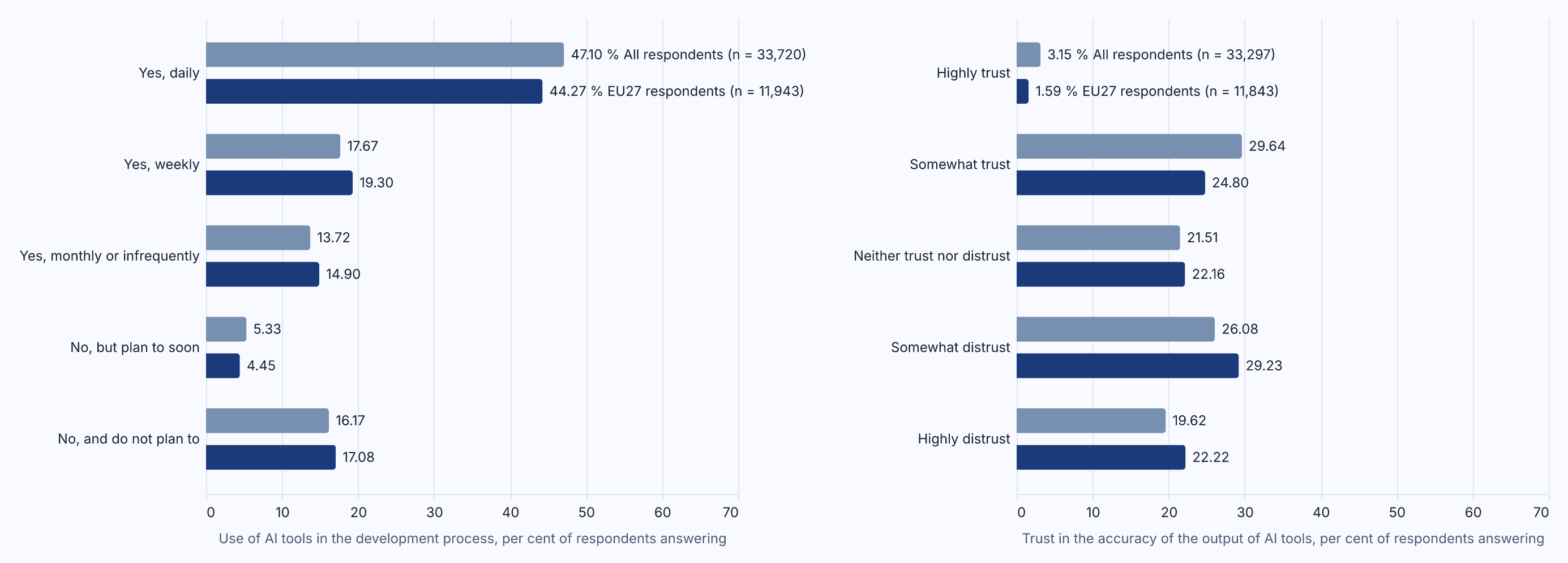
Figure 6.1: Heavy use and thin trust among developers in 2025: close to half use AI tools daily while about 3 per cent highly trust the output; a self-selected online sample, not a probability sample. Source: Stack Overflow, 2025 Stack Overflow Developer Survey (retrieved 2026).
The left panel of Figure 6.1 shows how often developers use AI tools in their development process. Of the 33,720 respondents who answered, 47.10 per cent used AI tools daily, 17.67 per cent weekly and 13.72 per cent monthly or infrequently; 16.17 per cent did not and did not plan to (28, Stack Overflow, 2025). The right panel shows the trust question of Question 13. The binary reads the two panels as a contradiction; the levels read them as one state. My reading is that this is what Level 1 Assisted looks like from the inside, the tool drafting and the person reviewing and executing. The survey did not ask at which level anyone worked or whether the review happens, so that is an interpretation and not a finding. Asked about AI agents, defined as software that can operate with minimal to no direct human intervention, 14.13 per cent answered daily, 8.99 per cent weekly and 7.83 per cent monthly or infrequently, and 37.85 per cent did not use agents and did not plan to (28, Stack Overflow, 2025). Even in the profession that builds agents, 30.95 per cent used them at least monthly, by my addition. The sample is self-selected and unweighted, and the EU27 rows are a filter on it, not a representative European figure.
Who is managed by a device
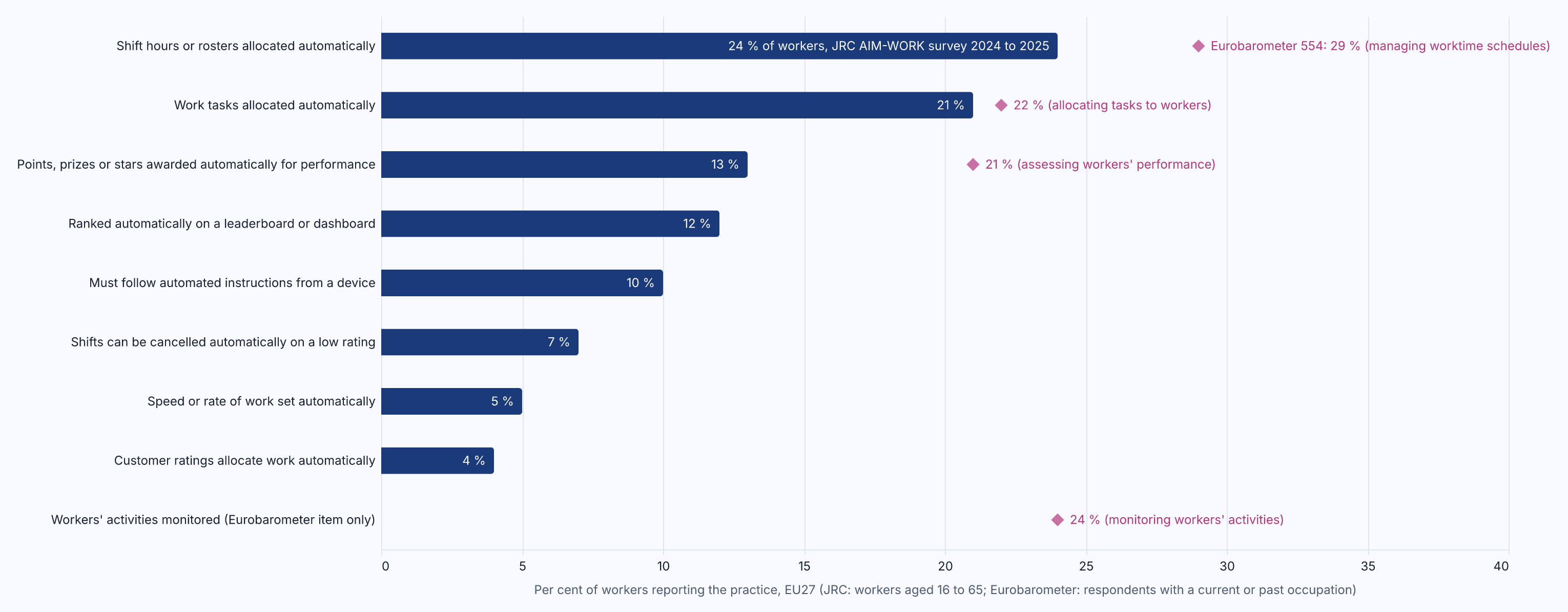
Figure 6.2: About a fifth of EU workers report that software allocates their tasks or rosters; far fewer report automated pacing, instructions or sanctions. Source: European Commission, Joint Research Centre, AIM-WORK survey (JRC143072, 2025), and Special Eurobarometer 554 (2025) (retrieved 2026).
Figure 6.2 shows the eight forms of automated management the AIM-WORK survey asked about, as the share of EU workers who answered yes to each, with the Eurobarometer's comparable items marked as diamonds. The two most common are the two the Nordvik tender was about: rosters or shift hours allocated automatically, 24 per cent, and work tasks allocated automatically, 21 per cent (51, Gonzalez Vazquez et al., 2025). After them the shares fall away: 13 per cent are automatically awarded points or prizes for performance, 12 per cent are ranked on a leaderboard, 10 per cent must follow automated instructions, 7 per cent could have shifts cancelled on a low rating, 5 per cent have the speed of their work set automatically and 4 per cent have work allocated by customer ratings (51, Gonzalez Vazquez et al., 2025). The Eurobarometer, asked of a different population in April and May 2024, puts task allocation at 22 per cent and worktime schedules at 29 per cent (29, European Commission, 2025).
The shape of the chart is the argument. If "automated" were one state, the eight bars would be of similar length; instead they describe a gradient. Allocating a task or a shift may be a proposal that a team leader or the worker can change, which the series would place at Level 2 Supervised or, inside agreed limits, Level 3 Bounded, or an assignment nobody reviews, which would be Level 4 Autonomous. Neither survey asked who could override the allocation, so the level cannot be read from them, and I leave that gap visible. What they do show is that the forms that arrange work, rosters and tasks, are reported far more often than the forms that press on a person directly: pacing, instructions and cancellation on a rating. Both are one snapshot and say nothing about where the bars are heading.
How the levels are drawn
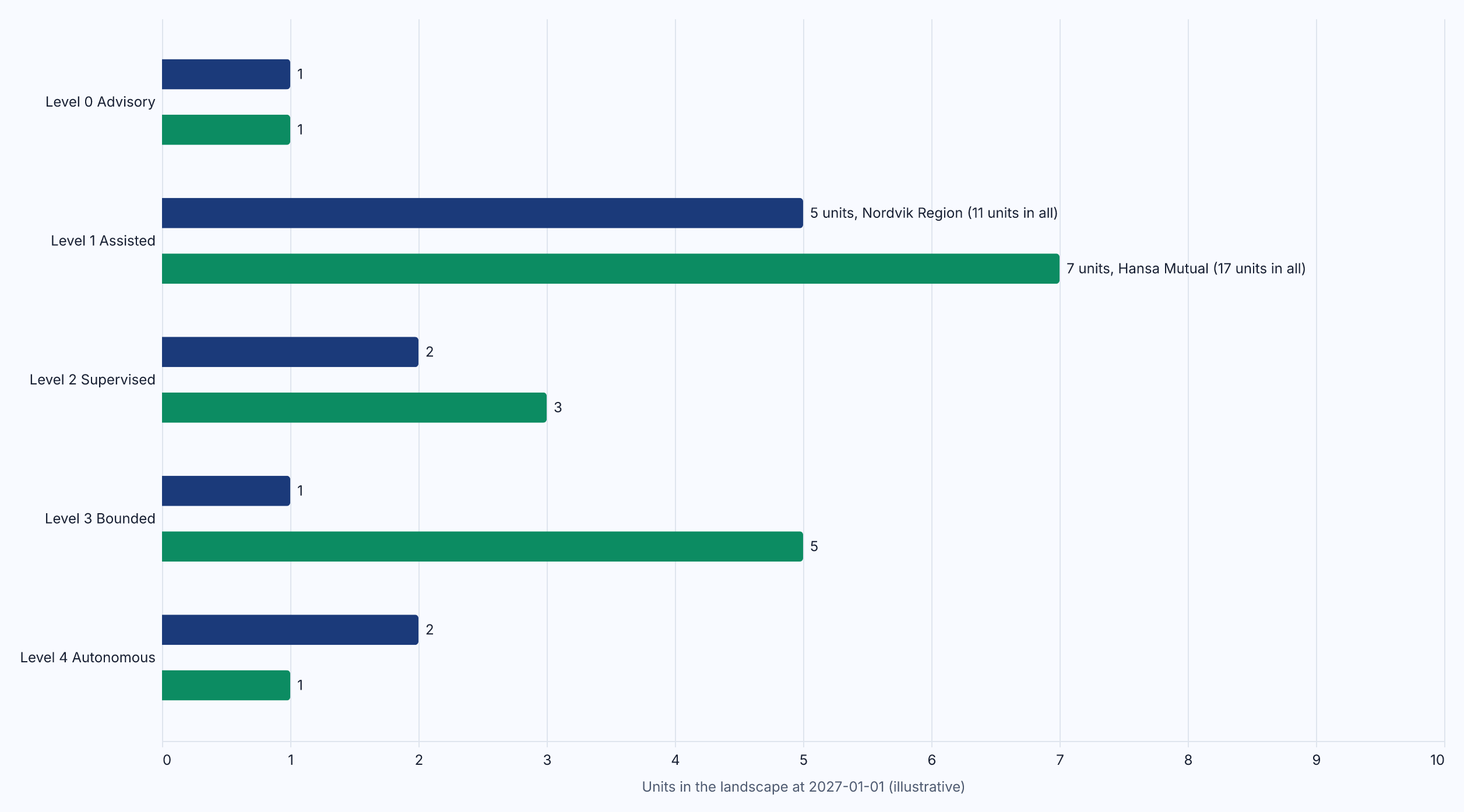
Figure 6.3: Illustrative: in the two landscapes of this book, Level 1 Assisted is the largest group of units, and the Level 4 Autonomous units are the ambient AI nobody chose and one public-facing assistant. Illustrative: counted from landscape/models/nordvik_region.yaml and landscape/models/hansa_mutual.yaml.
Figure 6.3 is not data. It counts the units in the two illustrative landscape models for Nordvik Region and Hansa Mutual at 1 January 2027, and the models were built to show the notation, not to measure European practice. Nordvik Region's 11 units divide as one at Level 0 Advisory, five at Level 1 Assisted, two at Level 2 Supervised, one at Level 3 Bounded and two at Level 4 Autonomous; Hansa Mutual's 17 divide as one, seven, three, five and one. Level 1 is the largest group in both, not a majority of either. The agents people picture when they say automated sit at Level 3 Bounded, inside playbooks, with a policy point and a seat. The units at Level 4 are not the agents: at Hansa Mutual the one Level 4 unit is HM-AMB, the AI features suppliers switched on inside licensed software, with no policy point, no named decision-holder and no evidence; at Nordvik Region the two are NR-AMB, the same kind of ambient AI, and NR-CS, the citizen-service assistant, which answers residents' questions without anyone approving each answer. The illustration makes the series' point and does not prove it: the binary would call the assistants manual and the agents automated, and miss that the units acting with no approval at all are the ones nobody decided to switch on, the blind spot AI Red Team, Chapter 8, describes for vendor AI in security products (4, Nordqvist, 2026).
Movement along the scale is recorded in the Nordvik Region model only. In the scenario of Chapter 18, the rostering system's open-shift class moves from Level 2 to Level 3 on 11 March 2027. Whether movement up the scale is typical of European organisations is speculation: the series argues that an action class can move from Level 2 to Level 3 when it is reversible and bounded and a policy point and a tested stop path exist, but no survey has measured the levels over time.
The picture corrected
Contour, the notation of this book, draws every AI use as one mark, and its horizontal axis is the autonomy level. That is the correction: five columns, not two boxes, and a mark has to be put in one of them. Figure 6.4 is Hansa Mutual's one-page landscape at the start of 2027, read along the columns rather than, as in Chapter 5, by colour. The organisation is illustrative; the picture is rendered from its landscape model.
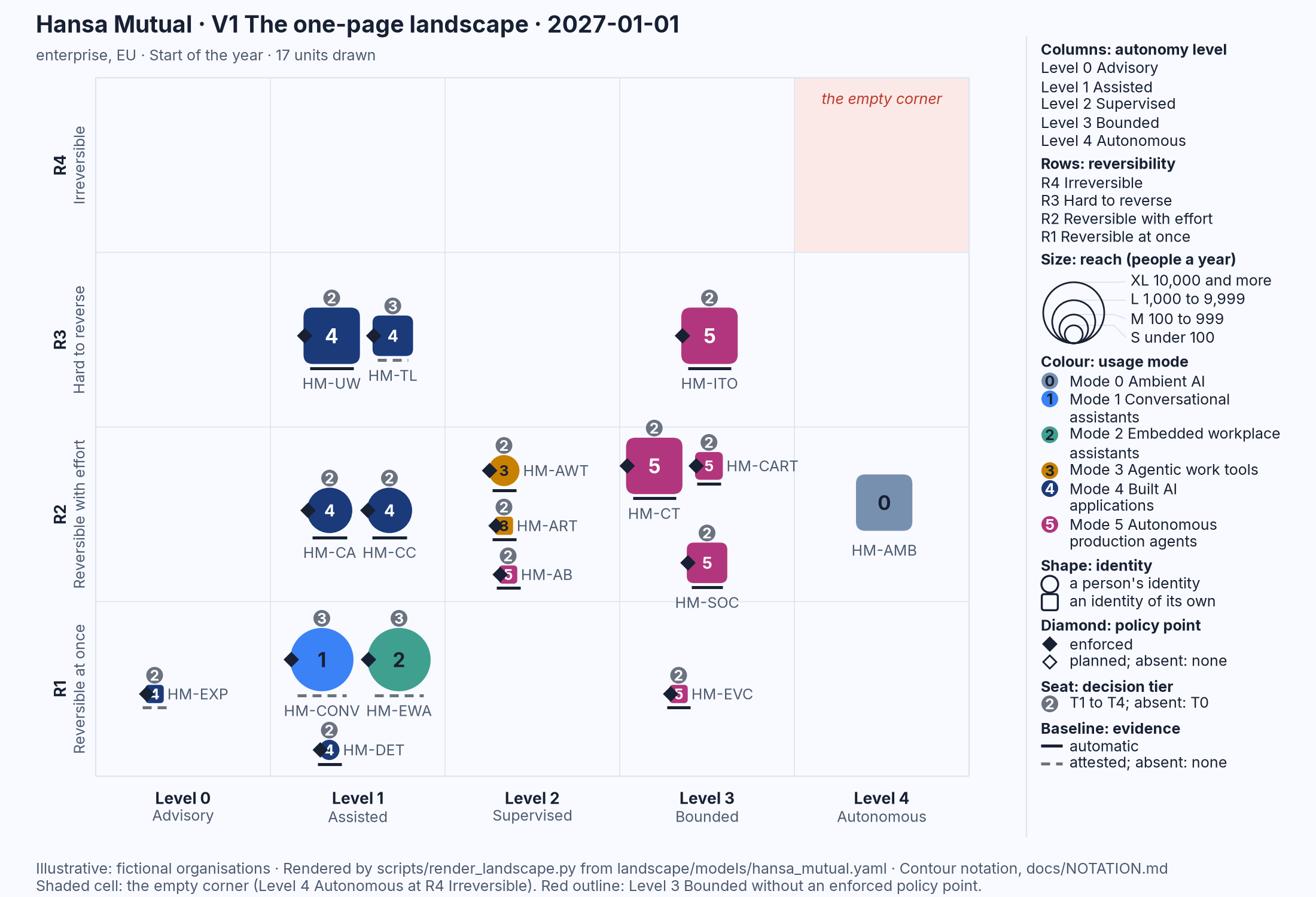
Figure 6.4: Hansa Mutual's landscape at the start of 2027 read column by column: one unit at Level 0 Advisory, seven at Level 1 Assisted, three at Level 2 Supervised, five at Level 3 Bounded and one at Level 4 Autonomous. Illustrative: rendered from landscape/models/hansa_mutual.yaml.
Read it from left to right. In the Level 0 Advisory column there is one small mark, HM-EXP, the exposure-management prioritiser, which only proposes. The Level 1 Assisted column is the crowded one: seven units, from the underwriting-support and recruitment-screening systems high up at R3 Hard to reverse to the conversational and embedded workplace assistants down at R1 Reversible at once. The Level 2 Supervised column holds the agentic work tools for engineers, the architecture review agent team and the agent-boss pilot. The Level 3 Bounded column holds the agents: the claims-triage agent, continuous automated red teaming, the SOC investigation agent, the IT-operations agent and the evidence-collection agent, each a rounded square with a filled diamond for an enforced policy point and a grey seat carrying the tier of the person who holds the decision right. Three of them share the R2 cell and are packed in a row, so that two sit on the cell's edges; the model places all three at Level 3. The Level 4 Autonomous column holds HM-AMB alone: no diamond, no seat, no baseline. The empty corner at the top right, Level 4 Autonomous at R4 Irreversible, is empty.
A reader who wanted to draw the binary onto this picture would have to decide where to put the line. Between Level 2 and Level 3, six units are above it and eleven are not, and the agents and the ambient AI fall on the same side, which is the one thing the picture shows they should not. The line is a choice, and the most defensible place for it is between a person approving each action and a person having approved a playbook.
The one-page landscape places each unit at the highest level it holds for any action that changes something outside the unit; read-only actions such as enriching an alert do not set the column. The decision-rights view opens the unit up and shows the levels per action class; Figure 6.5 is Hansa Mutual's at the same date.
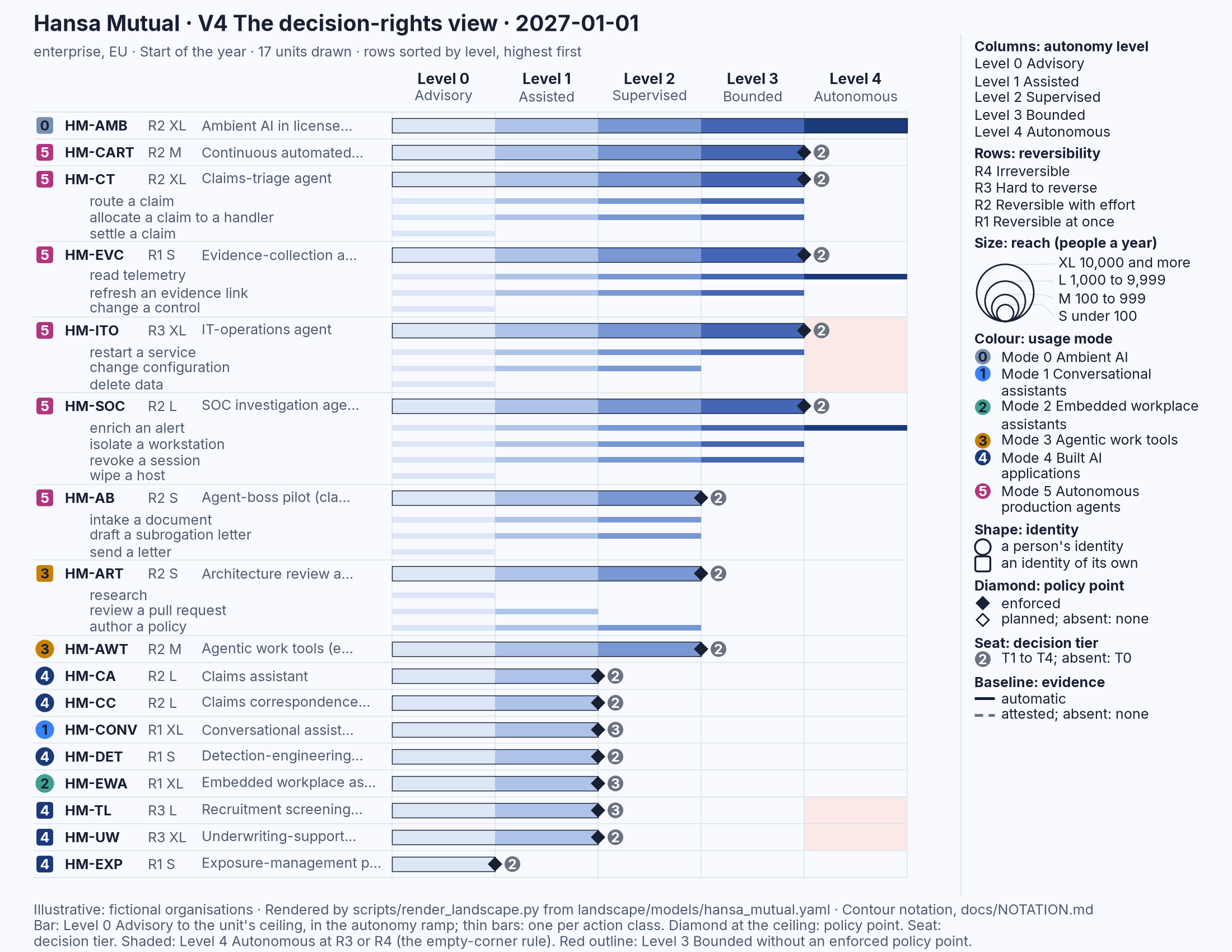
Figure 6.5: One unit, several levels: the SOC investigation agent HM-SOC enriches an alert at Level 4 Autonomous, isolates a workstation and revokes a session at Level 3 Bounded, and wipes a host only at Level 0 Advisory. Illustrative: rendered from landscape/models/hansa_mutual.yaml.
Each row is a unit; the bar runs from Level 0 Advisory to the unit's ceiling, the seat sits at the ceiling with its tier, and the diamond marks the policy point. Under a unit that holds more than one level, thin bars show the level per action class. Look at HM-SOC, whose ceiling is Level 3 Bounded and whose seat carries T2, the group chief information security officer as system owner. Enriching an alert runs to Level 4 Autonomous: nobody approves it, because it changes nothing outside the case record. Isolating a workstation and revoking a session run to Level 3 Bounded: the agent executes them within a playbook, and an analyst is informed and can stop it. Wiping a host stops at Level 0 Advisory: the agent may propose it and a person does it, because a wiped host is hard to reverse. Four actions, three levels, and the four together are the agent's mandate. In every Mode 5 unit whose model records action classes, the least reversible action sits at Level 0 Advisory: settling a claim, deleting data, wiping a host, changing a control, sending a letter.
On this view the line between Level 2 and Level 3 can be seen rather than read: it is the vertical between the third and fourth columns. Any organisation with a register of its AI uses can draw its own; Chapter 17 shows how.
The rule of thumb
Rule of thumb: Ask at which level, for which action: "automated" is five answers, not one.
Apply it whenever a sentence contains the word automated, autonomous, manual or human in the loop: ask which action is meant and which of the five levels it holds. A system described as automated may be Level 1 for most of what it does, Level 3 for a defined class and Level 0 for anything hard to reverse; a system described as having a human in the loop may be Level 2 with approvals given in seconds, which AI Red Team, Chapter 6, guards against by measuring time to approval, rejection rate and later reversals, because approval can become a reflex (4, Nordqvist, 2026).
The rule stops applying where the law has drawn a binary on purpose and the binary is the question. Whether a decision is based solely on automated processing under Article 22 of the GDPR is a yes-or-no question with legal consequences. The levels do not replace it, they tell you where to look: actions at Level 3 and Level 4, which no person approves one by one, are where the word "solely" is tested, and a Level 1 draft that a person reviews and executes is not. Nor are higher levels worse as such: a level is defensible or not in relation to the reversibility of the action.
What to do
For an executive
Strike the binary question from the papers that reach you and replace it with the table the rule of thumb produces. For every AI use you are asked to approve, ask for the action classes, the level of each, who holds the seat and whether a policy point enforces the level or a policy document merely describes it. When a supplier, a project or a newspaper says a function has been automated, ask which action moved above Level 2 Supervised, because that is the move that changes who answers for it. Where nobody recorded a level, the unit runs at a level nobody decided; establish it and record it.
For an architect
Record the level per action class in the landscape model, not only the unit's ceiling, so that the decision-rights view can be rendered. The fragment below is HM-SOC's entry as the Hansa Mutual model records it (illustrative). The level field is the ceiling that places the mark in the one-page landscape; action_levels is what the decision-rights view draws.
# landscape/models/hansa_mutual.yaml (fragment, illustrative)
- id: HM-SOC
  name: SOC investigation agent
  mode: 5                      # Mode 5 Autonomous production agents
  identity: own                # acts with an identity of its own
  level: 3                     # the unit's ceiling: Level 3 Bounded
  reversibility: R2
  reach: L
  policy_point: enforced       # a policy decision point outside the model
  decision_tier: T2
  decision_holder: Group CISO
  evidence: automatic
  action_levels:
    "enrich an alert": 4       # Level 4 Autonomous: changes nothing outside the case
    "isolate a workstation": 3 # Level 3 Bounded: within the playbook, stoppable
    "revoke a session": 3
    "wipe a host": 0           # Level 0 Advisory: a person does it
Every action class at Level 3 Bounded must be backed by an enforced policy point; the renderer outlines a Level 3 mark without one in red, and the rule is worth copying into a review checklist. Treat a change of level as a change event that reopens the review.
For a public official
In a tender, a fundamental rights impact assessment or an algorithm register entry, ask the supplier for the level per action class and write the answer into the contract, because a procured system's levels are the supplier's defaults unless the buyer sets them. In Nordvik Region's rostering tender the questions that mattered were at which level the system drafts a roster, offers an open shift and flags a breach of the rest rules, and who can change each answer. For a system that touches people's work, the AI Act, Regulation (EU) 2024/1689 as amended by Regulation (EU) 2026/1744, places systems intended to allocate tasks based on individual behaviour or personal traits or characteristics, or to monitor and evaluate the performance and behaviour of workers, in Annex III, the Act's list of high-risk uses, point 4(b), with the deployer duties that follow (39, European Union, 2024) (40, European Union, 2026). The levels per action show a supervisory authority, a union or a resident what the system does on its own and what a person still decides; publish them in the same words in the public register entry.
Nordvik Region and Hansa Mutual
Both organisations are illustrative, and each shows the instinct from a different side. At Hansa Mutual the binary would have called the five agents at Level 3 Bounded automated and stopped there. The decision-rights view says that the four whose model records action classes each hold two or three levels across three or four actions, with a named person in the seat on every row. The group's difficulty is proving the levels, not deciding them: its supervisors ask whether the stop path works at machine speed, which Chapter 17 takes up.
At Nordvik Region the binary came in through procurement and leaves through negotiation. The rostering system NR-SW is recorded in the Region's model with the HR director in the seat at T3. At the start of 2027 its mark sits at Level 2 Supervised for drafting a roster and for offering an open shift, and Level 1 Assisted for flagging a breach of the rest rules; its policy point is only planned, so the mark carries a hollow diamond. In the scenario of Chapter 18, the written delegation profile agreed with the unions on 20 January 2027 brings the policy point into force, and on 11 March the open-shift class moves from Level 2 to Level 3 inside that profile. In the binary's terms nothing changes between January and March: the system is "automated" throughout. What changes is that one action class crosses the line between Level 2 and Level 3, and the Region crosses it with a written profile and an enforced policy point.
Summary
The binary instinct sees automated or manual, human or machine, where the landscape has five levels. About 15 per cent of people aged 16 to 74 in the EU had used a generative AI tool for work in 2025, while a vendor survey found 59 per cent expecting AI to change their job within five years. Among developers who answered the Stack Overflow survey, close to half used AI tools daily and about 3 per cent highly trusted the output, which I read as Level 1 Assisted seen from the inside. About a fifth of European workers had tasks or rosters allocated by software, and far fewer had their pace set or their shifts cancelled by one: a gradient, not a state.
The five autonomy levels of AI Red Team, Chapter 6, replace the two boxes. The level belongs to an action in a context, not to a product; one unit holds several levels for several actions; and the line that matters runs between Level 2 Supervised and Level 3 Bounded. In the two illustrative landscapes the agents sit at Level 3 inside playbooks with policy points and seats, and the only units at Level 4 are the ambient AI nobody chose and one public assistant. Hansa Mutual's SOC investigation agent, with three levels across four actions, is the picture to keep in mind.
The rule of thumb is to ask at which level, for which action, because "automated" is five answers, not one. It turns a tick into a short table that an executive can approve, an architect can encode and a public official can write into a contract and a register. Chapter 7 takes up the model instinct: the habit of asking which model a system uses when the use, more than the model's name, sets the risk and the value.
Sources
- European Parliament and Council of the European Union (2016). Regulation (EU) 2016/679 of 27 April 2016 on the protection of natural persons with regard to the processing of personal data and on the free movement of such data, and repealing Directive 95/46/EC (General Data Protection Regulation). Official Journal of the European Union, L 119, 4 May 2016, p. 1. (41, European Union, 2016)
- Eurostat (2026). Individuals - use of generative AI tools. Online data code isoc_ai_iaiu, last updated at the source 5 June 2026; retrieved 7 November 2026 through the Eurostat dissemination API (JSON-stat 2.0) as the dataset data/eurostat_isoc_ai_iaiu. DOI: https://doi.org/10.2908/ISOC_AI_IAIU. (14, Eurostat, 2026)
- Gonzalez Vazquez, I., Fernandez Macias, E., Wright, S. and Villani, D. (2025). Digital Monitoring, Algorithmic Management and the Platformisation of Work in Europe. European Commission, Joint Research Centre, JRC143072; Publications Office of the European Union, Luxembourg, released 13 October 2025, catalogue number KJ-01-25-490-EN-N, ISBN 978-92-68-31994-9; based on the AIM-WORK survey of 70,316 individuals aged 16 to 65 in the 27 Member States; licensed under CC BY 4.0; the values quoted in the book are kept as the dataset data/jrc_aimwork_2025. DOI: https://doi.org/10.2760/9406086. (51, Gonzalez Vazquez et al., 2025)
- Ipsos (2025). The Ipsos AI Monitor 2025: A 30-country Ipsos Global Advisor Survey. Ipsos, June 2025; 23,216 adults interviewed online, and in India partly face to face, between 21 March and 4 April 2025 (vendor survey, self-funded by Ipsos); Ipsos's legal mentions deem polls published on its website to be in the public domain, usable with attribution to Ipsos; the values quoted in the book are kept as the dataset data/ipsos_ai_monitor_2025. (31, Ipsos, 2025)
- Stack Overflow (2025). 2025 Stack Overflow Developer Survey. Stack Exchange Inc.; survey open 29 May to 23 June 2025, results released 29 July 2025; more than 49,000 responses from 177 countries (self-selected online survey of Stack Overflow users); the results data are published in the archive repository github.com/StackExchange/Survey under the Open Database License (ODbL) 1.0, with cell contents under the Database Contents License (DbCL) 1.0, and are kept as the dataset data/stackoverflow_dev_survey_2025. (28, Stack Overflow, 2025)
- European Commission, Directorate-General for Employment, Social Affairs and Inclusion (2025). Artificial Intelligence and the future of work. Special Eurobarometer 554, Eurobarometer report; fieldwork 25 April to 22 May 2024 by Verian, 26,415 face-to-face interviews with residents aged 15 and over in the 27 Member States; published 13 February 2025. Publications Office of the European Union, catalogue number KE-01-24-018-EN-N, ISBN 978-92-68-21815-0; the values quoted in the book are kept as the dataset data/eurobarometer_ai_work_2025. DOI: https://doi.org/10.2767/8591026. (29, European Commission, 2025)
- Rosling, H., Rosling, O. and Rosling Rönnlund, A. (2018). Factfulness: Ten Reasons We're Wrong About the World – and Why Things Are Better Than You Think. London: Sceptre (Hodder & Stoughton), hardback published 3 April 2018. ISBN 978-1-4736-3746-7. (8, Rosling et al., 2018)
- Nordqvist, G. (2026). AI Red Team: AI as an Active Part of Cyber Defence in European Enterprises and Public Authorities. The Transformed Architecture, Book 4, published at aired.geon.se. (4, Nordqvist, 2026)
- Nordqvist, G. (2026). AI Platform and Security: Building and Securing AI Platforms in European Enterprises and Public Authorities. The Transformed Architecture, Book 3, published at aips.geon.se. (3, Nordqvist, 2026)
- Nordqvist, G. (2026). AI Governance: Governing Artificial Intelligence in European Enterprises and Public Authorities. The Transformed Architecture, Book 2, published at aig.geon.se. (2, Nordqvist, 2026)
- European Parliament and Council of the European Union (2024). Regulation (EU) 2024/1689 of 13 June 2024 laying down harmonised rules on artificial intelligence and amending Regulations (EC) No 300/2008, (EU) No 167/2013, (EU) No 168/2013, (EU) 2018/858, (EU) 2018/1139 and (EU) 2019/2144 and Directives 2014/90/EU, (EU) 2016/797 and (EU) 2020/1828 (Artificial Intelligence Act). Official Journal of the European Union, L series, 2024/1689, 12 July 2024; as amended by Regulation (EU) 2026/1744. (39, European Union, 2024)
- European Parliament and Council of the European Union (2026). Regulation (EU) 2026/1744 of 8 July 2026 amending Regulations (EU) 2024/1689, (EU) 2018/1139 and (EU) 2023/1230 as regards the simplification of the implementation of harmonised rules on artificial intelligence (Digital Omnibus on AI). Official Journal of the European Union, L series, 2026/1744, 24 July 2026; in force from 27 July 2026, the third day after publication. (40, European Union, 2026)